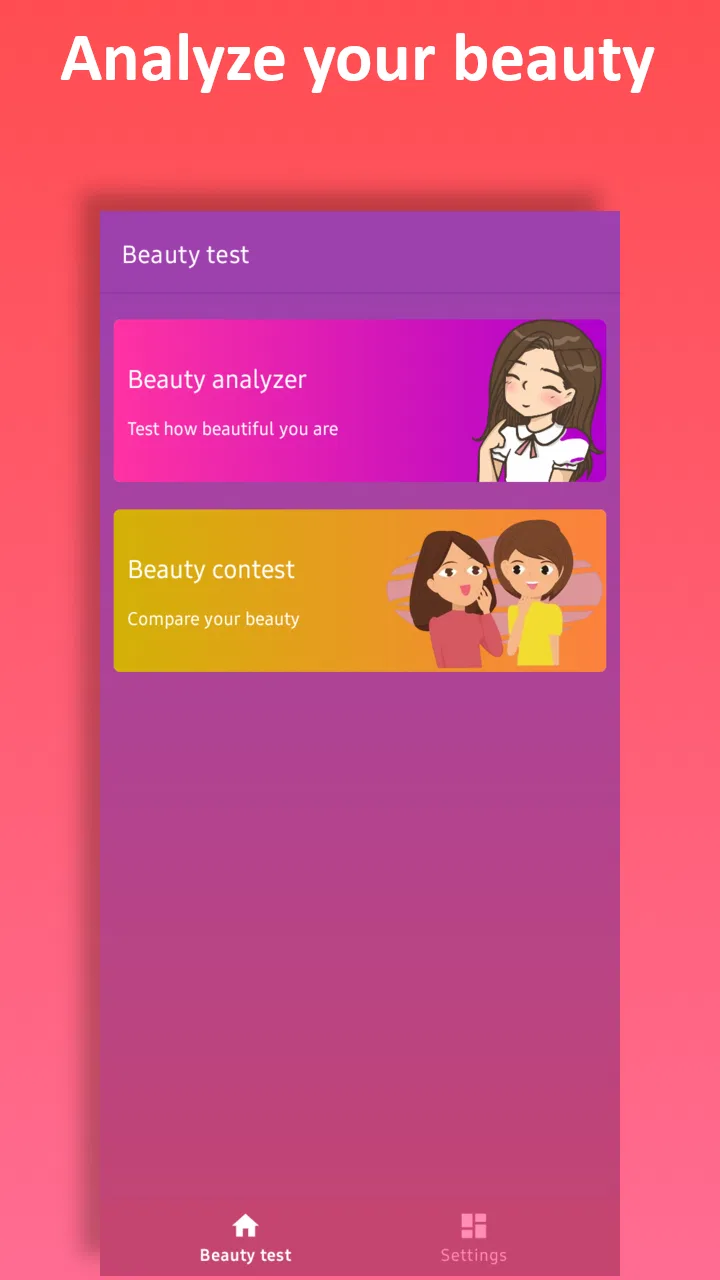
Beauty Calculator
- 0.0
- Rating
- 10.00K
- Installs
- Free
- Price

 Analysis by App-foxy
I tried Beauty Calculator as a lighthearted beauty app rather than treating its result as a serious judgment, and that distinction shaped my whole experience. The idea is immediately understandable: open a simple tool, receive a beauty score, and use the moment for curiosity, amusement, or a little confidence. It belongs to the beauty category, but it feels closer to a playful self-check than to a full skincare, makeup, or appearance-management companion.
That narrow purpose is both its appeal and its limit. In the first few uses, the app can be entertaining because the result gives you something immediate to react to. After that initial curiosity fades, the important question becomes whether the score changes what you do next. In my experience, Beauty Calculator is easiest to enjoy when I treat it as a private, occasional novelty rather than a daily authority on appearance. The score is best used as a conversation starter, not a definition of your looks.
From first-week curiosity to a longer-term test
I’d use this section to look beyond the first burst of curiosity and consider what might make an occasional return worthwhile. A helpful test is whether each visit answers a different, low-stakes question about a photo—such as how expression or framing changes its impression—rather than simply seeking a more reassuring score. That longer view also makes it easier to judge where the app’s simple design helps and where it may leave different users needing more support.
You May Also Like

 Pandora - Music & Podcasts
Pandora’s Music Is Easy to Start, but Harder to Recover
Pandora’s strength is its low-effort path from a seed to a station. Its weak spot is how much confidence it asks you to place in connection, setup, and quiet recovery.

 8 Ball Pool
 Is Built on Rivalries, Rematches, and Routine
A close look at the rivalries, rematches, shared routines, and unanswered safety questions that turn a quick pool match into a persistent mobile community.

 Samsung Music
’s Quiet Strength Is Playing What You Already Own
Its reach comes less from spectacle than from dependable access to a personal library. That simplicity is both the app’s strongest retention engine and its ceiling.

 AccuWeather: Weather Radar
AccuWeather Review: A Quick, Clear Forecast for Everyday Decisions
For everyday plans, the best forecast is the one you can understand quickly. AccuWeather makes rain timing, radar, and local conditions easy to act on, with a few trade-offs.

 Hill Climb Racing
Why Hill Climb Racing Still Turns Crashes Into One More Run
A tiny car, a bumpy hill and one more upgrade: Hill Climb Racing keeps resurfacing because its simple chaos makes every near-miss feel personal.

 AliExpress - Shopping App
AliExpress Makes Global Shopping Feel Personal, but Shoppers Bear the Risk
AliExpress turns a global marketplace into a pocket-sized discovery engine. Its reach is useful, its shopping loop compelling, and its trade-offs easy to miss.
More From Our News Desk
View All News


Why the first few uses feel appealing
The strongest part of the experience is the low barrier to entry. Beauty Calculator is free, and the app is aimed at Everyone, so it is easy to understand without needing specialist knowledge about cosmetics or skincare. The developer is gismael, and the current release is version 1.0, which gives the product a very focused, early-stage character rather than the feel of a large beauty platform packed with separate tools.
During the first week, the attraction comes from the simple promise of seeing a beauty score. That can be fun when you are testing the idea with a friend, checking how different photos are interpreted, or simply satisfying a moment of curiosity. It also has a small emotional advantage: the concept encourages users to think about attractiveness in a playful way instead of beginning with complicated routines, product catalogs, or detailed face analysis.
I can imagine using it before a social event, not because I would let the result decide whether I looked good, but because it creates a quick moment of self-awareness. Someone getting ready for a party might compare a casual picture with a more carefully chosen one and notice how lighting, expression, angle, and framing affect the impression. That is a more useful lesson than the number itself.
Another first-week use is sharing the experience privately with a close friend. The app can turn an ordinary conversation about profile photos or selfies into a small experiment. The important thing is to keep the tone relaxed. If someone is already anxious about their appearance, a score-based app can make that anxiety worse instead of providing encouragement.
What the score can and cannot tell you
A beauty score looks precise even when the subject is not. Beauty depends on personal taste, culture, expression, styling, context, and the mood of the person looking. A calculator can offer a playful signal, but it cannot measure warmth, confidence, personality, or the way someone looks in real life. I would therefore avoid reading a result as a fixed verdict.
This matters especially when comparing photos. A picture taken under soft daylight may create a very different impression from one captured in a dim room, even if the person has not changed at all. A tilted camera, a close crop, or an unfamiliar expression can also influence the outcome. My practical tip is to treat each result as belonging to that particular image, not as a permanent rating of the person in it.
That approach also answers an important question for families: is this suitable for younger users? Its Everyone age rating makes it broadly accessible, but accessibility does not remove the need for context. I would not encourage a child or teenager to chase a higher score or use the app to compare their worth with someone else’s. Used as a harmless curiosity, it may be fine; used repeatedly for reassurance, it can become an unhealthy habit.
How it compares with familiar beauty apps
Beauty Calculator is much narrower than a typical beauty editor. Makeup apps usually offer filters, virtual cosmetics, retouching, or style experimentation. Skincare apps tend to focus on routines, ingredients, reminders, or product guidance. Photo editors provide control over the final image. This app sits apart from those alternatives because its central experience is receiving an evaluation rather than changing, planning, or improving an appearance.
That difference makes it easier to start but gives it less practical depth. If I want to decide which photo to use for a profile, a conventional photo editor may be more useful because I can compare crops and lighting directly. If I want a routine I can follow over several weeks, a skincare tracker is the better choice. If I want a playful result with almost no learning curve, Beauty Calculator has a clearer advantage.
The trade-off is important: alternatives often give me an action after the first interaction, while this app mainly gives me a reaction. That can be exactly what a curious user wants, but it also explains why the novelty may wear off quickly.
The first-week workflow I found most sensible
I would use the app in a short, controlled sequence rather than opening it repeatedly throughout the day. First, choose one ordinary photo instead of searching for a perfect image. Next, note the result without immediately retaking the picture. Then, if curiosity remains, try one meaningful change, such as a different angle or a more natural expression. This turns the experience into a small observation about photography rather than a hunt for validation.
A second useful workflow is to compare the score with your own reaction before seeing the result. Ask yourself whether you like the photo, whether it feels natural, and whether it represents you well. Only then look at the calculator. That order keeps your personal judgment in the lead and prevents the app from becoming the first voice you hear about your appearance.
I would also avoid treating repeated checks as a progress system. There is no lasting benefit in trying to force a better result from minor changes unless the process is genuinely entertaining. Once the experiment stops teaching you something about presentation, it is probably time to close the app.
What happens after the novelty fades
The month-to-month value is the central challenge. Beauty Calculator does not naturally create a routine in the way a reminder-based skincare tool, a makeup planner, or a photo diary might. Its recurring value depends on whether you enjoy occasional experimentation. If you do, it can remain a small amusement that you revisit when choosing a photo or sharing a laugh with someone you trust.
If you expect a continuing beauty program, the experience is likely to feel thin. A score alone does not teach me how to care for my skin, select products, improve photography, or build confidence. It also does not replace professional advice when the concern is a genuine skin or health issue. For those needs, a more specialized app or a qualified professional would provide a stronger foundation.
The app’s free price helps here because it lowers the cost of keeping it installed for occasional use. Still, free does not automatically mean valuable. An app earns permanent space on my phone when I return to it for a clear reason. With this one, that reason is mostly curiosity, entertainment, and occasional photo reflection. That may be enough for some people, but it is not a strong monthly habit for everyone.
Three ways to give it recurring value
The first is to use it as a photography-awareness tool. Instead of asking, “Am I attractive enough?” ask, “What did this image communicate?” Compare a relaxed expression with a posed one, or a close selfie with a photo taken from farther away. The score is not reliable proof of beauty, but differences between images can encourage more thoughtful choices about lighting and composition.
The second is to make it an occasional social activity with clear boundaries. A group can compare the effect of expressions or framing, but nobody should be ranked as the most attractive person. Turning the focus toward the photo rather than the person reduces the chance that the app becomes a source of embarrassment or competition.
The third is to use it as a reminder to question automated judgments. If a result feels surprising, that is an opportunity to notice how quickly people grant authority to a number. I found this more interesting than trying to optimize the score. The app becomes more worthwhile when it encourages media literacy and self-reflection instead of endless checking.
The maintenance burden is low, but the emotional burden can rise
From a practical standpoint, maintaining a small app like this is straightforward. It is available as a free beauty app, the current version is 1.0, and it supports Android 10 or later. Those details make the installation decision simple for compatible Android users. There is no need to build a complicated routine around it, and its focused purpose means I do not have to spend time learning a large system.
The more serious maintenance issue is behavioral. If you use it once every few weeks for amusement, it asks very little of you. If you start checking before every social interaction, retaking photos until the result feels acceptable, or comparing yourself with friends, the app begins to demand attention without offering dependable insight. That is the point at which I would remove it or take a long break.
One practical safeguard is to decide in advance what question you are asking. “Which photo feels more natural?” is a useful question. “Do I look good enough today?” is much harder for any calculator to answer responsibly. Keeping the purpose specific prevents a casual tool from becoming an emotional measuring device.
Where fatigue begins
The first source of fatigue is repetition. Once you understand the basic interaction, another score may not feel meaningfully different from the previous one. Without a broader routine, educational layer, or creative editing process, the experience can become predictable.
The second is the false sense of objectivity. A number can make a subjective opinion look scientific, and that presentation may encourage users to focus on small changes that do not matter in real life. I would be especially cautious about using the result to make decisions about dating, friendships, work, or self-worth.
The third is the gap between evaluation and action. A result may be interesting, but what should you do with it? If the answer is always “take another picture,” the cycle becomes repetitive. A photo editor can let you crop or adjust an image; a skincare app can suggest a routine; a style app can help plan an outfit. Beauty Calculator does not occupy those same practical roles, so its usefulness depends heavily on the user’s own interpretation.
There is also a fatigue risk for people who already spend too much time comparing images online. In that situation, the app may reinforce the habit rather than interrupt it. I would skip it if you are looking for reassurance about an insecurity, if numerical ratings affect your mood strongly, or if you want concrete guidance on skincare, makeup, or personal style.
Who will enjoy keeping it installed
I think Beauty Calculator suits curious users who want a quick, uncomplicated beauty-themed experiment. It can work for someone choosing between photos, a friend group looking for a playful activity, or an adult who understands that automated scores are limited. Its free access and Everyone rating make it easy to try, while the focused design keeps the learning curve small.
It is less suitable for anyone expecting a complete beauty assistant. There is no reason to choose it over a specialized alternative if your main goal is tracking products, planning treatments, editing portraits, or receiving professional-level guidance. It is also not the right tool for making important personal decisions based on appearance.
The developer, gismael, has presented a very direct concept, and that directness is refreshing. The app does not need to pretend to be a complete lifestyle system to be enjoyable. At the same time, the narrow concept means the burden is on me to use it thoughtfully. Its value comes from the context I provide, not from treating the score as a final answer.
My long-term verdict
After the first-week appeal, Beauty Calculator becomes a question of habit. I would keep it installed if I enjoyed occasional photo experiments and could use it without seeking emotional approval from the result. I would not make it part of a daily beauty routine, because the score does not offer enough ongoing guidance to justify repeated checking.
The app earns a small place as a novelty, especially for users who want a free and accessible way to explore how photos can change the impression of appearance. Its lasting value improves when I use it to examine lighting, angles, expressions, and my own reactions. It weakens when I expect the calculator to tell me how attractive I am in any complete or lasting sense.
My recommendation is therefore selective. Try it if you can keep the experience playful, set a clear purpose, and accept that a score is only one shallow response to a complicated subject. Skip it if you want practical beauty advice or if ratings tend to control your confidence. Beauty Calculator is worth an occasional look, but it does not quite earn the status of a permanent beauty companion.
FAQs for Beauty Calculator
01What is the Beauty Calculator app and how does it work?
The Beauty Calculator app is designed to analyze facial features based on symmetry, proportions, and other aesthetic factors to provide a beauty score. Users upload a photo, and the app uses algorithms to assess the image, giving feedback on areas such as skin tone, facial symmetry, and feature alignment. It's important to remember that beauty is subjective, and the app is just a fun tool.
02Is the Beauty Calculator app safe to use regarding privacy?
Yes, the Beauty Calculator app is built with user privacy in mind. It ensures that all photos uploaded for analysis are securely stored and not shared with third parties. Users should review the app’s privacy policy to understand how their data is handled. Always ensure you are downloading from a reputable source to avoid privacy risks.
03Can the Beauty Calculator app be used for all skin tones and facial features?
The Beauty Calculator app aims to be inclusive, analyzing a diverse range of skin tones and facial features. However, like any algorithm-based tool, it may not always perfectly capture the nuances of every individual. The app continues to update its algorithms to improve accuracy and inclusivity, but users should view the results as a general guide rather than a definitive assessment.
04Are the results from the Beauty Calculator scientifically accurate?
While the Beauty Calculator uses advanced algorithms to provide beauty scores, the results are not scientifically verified. The app is designed for entertainment and self-reflection rather than as a precise scientific tool. Users should consider the results as part of a broader self-assessment and not as an absolute measure of beauty.
05Does the Beauty Calculator app offer any customization or additional features?
Yes, the Beauty Calculator app often includes features beyond just beauty scoring, such as personalized beauty tips, skincare recommendations, and the ability to track changes over time. Users can often customize their experience by selecting specific areas of interest or setting goals within the app, making it a versatile tool for beauty enthusiasts.
Pros
- User-friendly interface
- easy navigation.
- Accurate beauty score calculations.
- Customizable beauty standards.
- Supports multiple face analysis features.
- No ads in the premium version.
Cons
- Limited features in the free version.
- Requires good lighting for accuracy.
- Occasional app crashes reported.
- Privacy concerns with photo uploads.
- Limited support for non-standard beauty types.

Beauty Calculator
Gallery